Wednesday, June 01, 2011

Rapture Ready

Its been far too long since I've last posted here and today's post is, I admit, something of a cheat. It was actually written for my other blog. Truth is, I am not blogging very much at all anymore, so when I had a post I thought relevant to both blogs, I decided to share it on both. I hope you enjoy.


Still here? Me too. As everyone knows, the end of the world came and went on the 21st of May. Harold Camping, a television minister who preaches a numerological based form of end time prophesy, had predicted that at 6 p.m., in each consecutive time zone, God’s judgment would begin with earthquakes and the righteous being “raptured” to meet the Lord. In the thirty years since I’ve become a Christian I’ve run into these ideas before, though never one that generated as much media interest, and never one that has generated as much contempt—not just within the groups that you’d expect, but within the Christian community as well.

But for all the attention Camping drew to the idea the God was going to ‘rapture’ His people away, there was little discussion of what exactly is meant by the concept. There was even less discussion of how it is actually a new teaching—one unheard of before the mid-nineteenth century, when it was promoted by an Irish clergyman named John Nelson Darby. Darby’s teaching, collectively called Dispensationalism, would later form the basis of the Schofield Study Bible (1909), which would promote it throughout the US and UK. A distinctive feature of Dispensationalist eschatology, the study of the end times, is the idea that the Church will ascend to meet Jesus in the air before His actual return to set up an earthly kingdom. A lot of terrible things will precede Christ’s return, but Darby taught that the Church would not have to suffer through them. Christ would take His people safely out first. In spite of efforts by its advocates to prove otherwise, no one taught this doctrine before the rise of Dispensationalism.

Eschatology has always been an important part of Christianity. Arguably Christianity itself grew out of Jewish eschatology and the expectation that the Messiah was coming and that he would bring justice for his people and peace on earth. When the Messiah did come (hey, I am a Christian after all), things didn’t quite meet their expectations. He came, sure, but instead of setting up an earthly kingdom He set up a spiritual one. He was crucified, buried, resurrected, and ascended into Heaven, promising to come again and bring about the sort of triumphant new world the Jews had been expecting in the first place. The first generation of Christians fully expected to see this happen in their lifetime. When some of them died without seeing it, others began to worry. Paul wrote to believers in Thessalonica:
But we do not want you to be uninformed, brothers, about those who are asleep, that you may not grieve as others do who have no hope. For since we believe that Jesus died and rose again, even so, through Jesus, God will bring with him those who have fallen asleep. For this we declare to you by a word from the Lord, that we who are alive, who are left until the coming of the Lord, will not precede those who have fallen asleep. For the Lord himself will descend from heaven with a cry of command, with the voice of an archangel, and with the sound of the trumpet of God. And the dead in Christ will rise first. Then we who are alive, who are left, will be caught up together with them in the clouds to meet the Lord in the air, and so we will always be with the Lord.

1 Thessalonians 4:13-17
And in the next chapter he wrote:
Now concerning the times and the seasons, brothers, you have no need to have anything written to you. For you yourselves are fully aware that the day of the Lord will come like a thief in the night. While people are saying, "There is peace and security," then sudden destruction will come upon them as labor pains come upon a pregnant woman, and they will not escape. But you are not in darkness, brothers, for that day to surprise you like a thief. For you are all children of light, children of the day. We are not of the night or of the darkness. So then let us not sleep, as others do, but let us keep awake and be sober. For those who sleep, sleep at night, and those who get drunk, are drunk at night. But since we belong to the day, let us be sober, having put on the breastplate of faith and love, and for a helmet the hope of salvation. For God has not destined us for wrath, but to obtain salvation through our Lord Jesus Christ, who died for us so that whether we are awake or asleep we might live with him. Therefore encourage one another and build one another up, just as you are doing.

1 Thessalonians 5:1-11
While they often cite of verses as well, these two passages are the hooks on which the Dispensational idea of a separate “rapture” of the Church hang. Verse seventeen of chapter four, highlighted in the first quote, describes the Church rising to meet Jesus on His return. But what Paul is writing about is not the escape of the Church. He is addressing a concern that members of the Thessalonian church had regarding those who had died waiting for the Second Coming. Paul assures them that all of Jesus’ followers will rise to meet Him, not just those still living when it happens, and that’s how it was understood for almost the entirety of Christian history.

Verse nine of chapter five, highlighted in the second quote, is quoted to prove that the Church will not have to suffer the wrath God will pour out on the Earth before He returns, but the point Paul is making here is that the Church is meant to walk uprightly and that we should do exactly that. We were not meant for Hell, the “wrath,” but for Heaven. And, again, that’s how it was understood through most of Christian history.

When I say these interpretations were held for most of Christian history, I mean universally held. They are still held by the majority of Churches. One of the interesting things about Dispensationalism and being ‘rapture ready’ is their dominance over Christian media, particularly in the US. It’s a dominance that tends to overshadow other positions. Historically, most Americans followed the Calvinist teaching of the Puritan forefathers and were Postmillenialists, believing that the coming of the Lord would be ushered in by the evangelical work of the Church, which would create a universally Christian world and only then would Jesus come.

Being a Pentecostal, pre-tribulation Dispensationalism was one of the first things I was taught. Almost immediately I saw that the idea of the Church escaping the Great Tribulation, as its called, was inconsistent with many scriptures and I adopted what is called the “post-trib” position. This accepts the historic—and, yes, scriptural—teaching regarding the Church and the tribulation, but retains the Dispensationalist understanding of the Bible and the Church. Over time, however, due to the inconsistencies of Dispensationalism, I studied the matter out and rejected it altogether. (This was one of the first things I blogged about.) Ultimately I decided that what was more important than any of the ‘isms’ was that I be ready. That I walk as a Christian each day, living the values I profess, so that I will be ready whenever He comes. Whenever that happens.

Tuesday, March 15, 2011

All Or Nothing: A Short History Of Abstinence In America

By Jessica Warner
McClelland & Stewart, 2008

Abstinence has been a mainstay of public debates and private discourse for two hundred years now, and in All Or Nothing: A Short History Of Abstinence In America Jessica Warner gives us a brief overview of its origins and the first century of its development.

Beginning with early attempts to curb the use of hard liquors at a time when their consumption was much higher than today, it quickly came to call for the abstention from all stimulants, including caffeine, drugs, and even spicy food. Armed with an optimistic outlook towards individual achievement and Jacksonian anti-intellectualism, the movement “had an almost morbid fear of leisure” (p. 27). It appealed to middle class Northerners, particularly those who had few vices to give up in the first place, but it made few inroads towards curbing the vices of those who did. Soon it moved from advocating moral suasion to calling on legislative solutions. It’s a pattern that continues today.

If I had a complaint about this book, it would be that its too short. Yes, it is call a short history, I know, but too much is left out or left unaddressed. Warner links the movement to Wesleyan perfectionism and the later Holiness movement, but doesn’t really explain what they were, or how their intellectual underpinnings could lead to an abstinence movement. She correctly notes that “moderation went from being a virtue to a vice” (p.37), but gives scant attention to why this shift should be so consistent and so powerful. Her discussion of the past century, the activism that effects us most today, is restricted to an eight page epilogue. Again, I know it’s a self-described short history, but as far as I know she wasn’t working under any page restrictions.

Also, she seems to be taking backhanded shots at Catholics. For example, the YMCA’s rationalization for distributing cigarettes, but not alcohol, is described as “Jesuitical.” She does this several times. Is she trying to be ironic, given views on Catholics at the time? Could it reflect views of the author? I don’t know. Its strange.

The abstinence movement is an important one and impacts us, both from the left and the right, every day. It deserves a serious, popular history. Maybe someday Warner will finish writing it.

Thursday, March 03, 2011

No Christian Foster Parents

Britain's High Court has ruled against a Pentecostal couple from Derby, saying that their Christian views on homosexuality made them unfit to be foster parents. Its important to note that no one at any time has accused the Johns of actually discriminating against anyone. Indeed, a 2008 assessment of the couple, who had been foster parents since the 1990s, described them as “well-meaning... kind and hospitable people who would always do their best to make a child welcome and comfortable”. But the same assessment quizzed them on their beliefs about homosexuality and based on their answers it was decided that they should not be allowed to continue caring for foster children, ages 5-8.

Again, its important to reiterate that the Johns have not discriminated against anyone, nor have they been accused to discriminating against anyone. Theirs was a thought crime.

Wednesday, March 02, 2011

Christian Lawmaker Murdered In Pakistan

Anti-Christian violence continues in the Islamic world:
A leading Pakistani Christian lawmaker who had campaigned for reform of the country’s blasphemy laws was shot dead on Wednesday, adding to concerns the government is unwilling or unable to check Islamic extremism...
Someone asked me yesterday where I stood on the Tribulation. I think its far easier to believe we're in it, than on the eve of it.

Friday, January 14, 2011

The Bible Storybook


Comics illustrator Ovi Nedelcu has started a new blog, where he is telling the stories of the Bible. I'm afraid I don't know anything about the guy, but his work looks interesting and is worth checking out.

(Click on the image to enlarge it.)

Friday, January 07, 2011

Christian lambs left to slaughter

The Sydney Morning Herald has an interesting analysis of on the recent anti-Christian violence in the Middle East.

Saturday, January 01, 2011

Happy New Year

January the first. Again. I'm not going to be making any resolutions, but I am going to try blog more consistently in the coming year. Twenty-ten wasn't a great year, so much of it seemed to be spent struggling just to stay in place, but I am going into this new year feeling optimistic.

I had hoped to put up a video from this year's Christmas pageant, but my wife taped the entire thing and its just too long to load up. I intend to cut out just a couple of minutes, but my efforts to date have been less than successful. Program compatibility problems, etc. I have a friend who'll do it, but his brother just died, so I'm not about to bother him with it right now.

At home here we've had a great success with our family altar. With my wife and I working different shifts, its not easy to schedule anything, but lately we've been very consistent and I feel we're laying a solid foundation.

I do intend to go forward with the Matthew study soon. I am actually doing another study right now. That's just like me. Start a million things and, hopefully, finish one or two. That's something else I need to work on this year.

And, of course, I will continue to post links to news items. Here's a couple from this weekend: A car bomb went off outside an Egyptian church today, killing 21, wounding dozens, and in Pakistan Islamist parties rallied to support blasphemy laws used to discriminate against religious minorities.

Saturday, November 13, 2010

The Exorcists Return

The Catholic Church's attempts to push back at Vatican II are taking some strange turns. According to the New York Times, a conference of American bishops, held this week in Baltimore, was focused on properly identifying the demonic and when an exorcist is needed.

Monday, November 01, 2010

Death Toll Rises

The number of dead in the Our Lady of Salvation Church massacre has risen to 58. It is the single worse attack on the country's Chirstian minority since the American invasion.

Sunday, October 31, 2010

Attack In Iraq

At least ten Chaldean Christians, including a priest, and almost as many Iraqi police and soldiers, were killed by terrorists today. Early reports are that the attackers were not Iraqis. Since the American invasion attacks on Iraqi Christians have caused most of the community to flee.

Friday, September 10, 2010

The Five Fold Ministry

I've just finished The House Church by Wolfgang Simson. An interesting book. He doesn't make a lot of jokes, but he does make this humorous analogy on p. 64:
For a hands-on picture, let us compare the fivefold ministry to the five fingers of the hand. The apostle is the thumb; he gives stability, holds the counterbalance, and can literally touch all the other fingers. The prophet is the index finger; he points at you and says, “You are the man (or woman)!” The evangelist the middle finger, the longest of all, sticking farthest out into the world. The ring finger resembles the pastor/shepherd, caring for internal relationships. The little finger is the teacher; he can worm his way deep into any ear, and there share the truth of the gospel.

Saturday, September 04, 2010

Religiosity and Riches


Click on the image to see it in its entirety.

This was taken from a New York Times article, Religious Outlier, by Charles M. Blow. He is discussing a Gallup poll correlating religion and wealth.

Sunday, August 08, 2010

House Churches

About five weeks ago I posted about the end of my 1,000 days and how some things were still playing out. One of those things was house churches. Meeting in small groups at home, instead of in church buildings. This is becoming more common--common enough to be considered a movement--but as nudged towards it as I felt, I did nothing. My church isn't a house church and I don't feel led to start up a house church of my own. This month our Pastor decided to move of mid-week Bible study out of our fellowship hall and into our homes. Interesting...

Its still very much a work in progress and he doesn't know yet whether we'll continue into the fall, but I want to get all I can from the experience while it is available to be had.

A Quote For The Day

“When the church wins the culture wars, it inevitably loses. When it conquers the world, it becomes the world. When you put your trust in the sword, you lose the cross.”

Rev. Gregory A. Boyd
Woodland Hills Church
MAPLEWOOD, Minn.

Monday, August 02, 2010

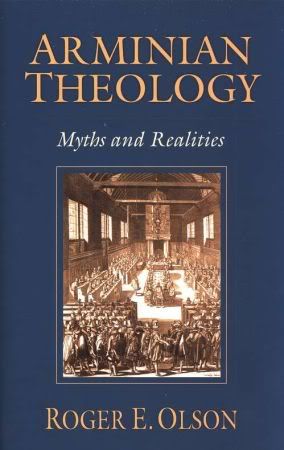
Arminian Theology: Myths and Realities

By Roger E. Olson
Published byInterVarsity Press, 2006

Roger E. Olson grew up in a Pentecostal household and has always been an Arminian. Surrounded by Pentecostals, most of the people he knew were also Arminians and so he never felt the need to question or defend the teaching until he got out into the broader Evangelical world. There he ran into Calvinism. I wrote earlier about the Evangelical tendency to avoid doctrinal debate through slander and disinformation. Olson, who is seeking a rapprochement with Calvinists, would never be so blunt, and puts down these ‘myths’ to misunderstandings and ignorance. Perhaps that’s fair. Certainly as these myths circulate, they get repeated by people who have no reason not to take them at face value, but if you’re going to expound on a subject, then you owe to yourself and those you are teaching to learn the truth.

Here Olson’s book provides a solid foundation. He addresses ten common misconceptions about Arminianism, contrasting it with Calvinism. For example, ‘Myth Four: The Heart of Arminianism Is Belief in Free Will.’ When I first studied this subject, about ten years ago, it was because of an interest in free will, but that’s not what Arminius was concerned about. Calvinism teaches a God so completely in control of the world that everything that happens is an expression of His will. His grace is so effectual, that all who God wills to be saved must be saved. Arminius realized that if this were the case, then God is the author of sin and that the Fall of Man could only have happened because it was God’s will that we sin. If God determines who will be saved, He, at the same time, determines who will be damned. This, argued Arminius, was wrong and contrary to the God revealed in scripture. It is not God’s will that any perish. If some do perish, and we know that some do, then there must be some element of free will that allows us to accept or reject His will for us. Arminius was not concerned with free will, per se; he only sought to protect the character of God from what is implicitly taught by Calvinism: that God created sin and condemned people to Hell long before they were even born.

Dr. Olson’s book is both a solid introduction to Arminianism and a strong defence against much of the disinformation that has been circulated about it, but I did have a couple of problems with it. The first concerns structure. Olson wrote each chapter so that it could be read without consulting the other chapters. I understand why. I spent many years in university and it’s an environment that teaches lazy reading. You’re after information and want it as quickly and as easily as possible. But if you are reading the book from cover to cover, it is incredibly repetitive. Rather than assume you’ve read the previous chapter, he repeats points again and again. Olson warns readers of this, but it was still very trying. Another structural problem is that the headers on each page list the myth being addressed in the chapter, but not that it is a myth. Consequently, the same lazy readers the repetition is meant to serve will open the book to, for example, page 160 and see “Arminianism Is Not a Theology of Grace,” instead of “Myth 7: Arminianism Is Not a Theology of Grace.” If you are going to spoon feed information, why stop at half measures?

The second problem is more serious, but also a logical result of Olson’s intentions. Because his goal is the acceptance of Arminius’ teachings within Reform--read: High Calvinist--circles, he makes little reference to the 1500 years of Church teachings that preceded the Reformation. In reality, Arminius’ doctrines were far more in keeping with traditional Christian teachings than Calvin’s. Yes, there were determinist theological teachings before the Reformation, but where were they adopted as formal doctrinal positions? No where. But by treating Calvinism as a norm to be measured against, he creates an inverted little world in which Arminius is always on the defensive. All of the myths addressed in this book assume Calvinism is the norm. All of the Reformation first generation of leaders, Calvin included, were trained as Catholic theologians first and later rejected aspects of Catholicism they believed to be unscriptural and unchristian, but they didn’t start again from scratch. This sort of contextualization could only serve to strengthen the legitimacy of Arminianism as a traditional Christian teaching, but Olson doesn’t give it because he is seeking acceptance form people who would only hold it against him (adding an eleventh myth, that Arminianism is too Catholic or Orthodox).

These criticisms aside, Arminian Theology makes for a great introduction to the subject and I would recommend to anyone interested in the debate.

Friday, July 02, 2010

One Thousand Days Plus

Last week saw the end of my one thousand days. A thousand days ago I set myself a goal. I had grown more and more unsatisfied with where I was spiritually and gave myself this period to set things straight. To set a new course. Somehow.

Many of the important things, however, are still playing themselves out. Events, decisions to be made, have not run their course, in spite of my self-imposed date. I’ve developed some good habits, become interested in some areas of study, but the conclusion of my course? It hasn’t arrived. ‘Why?’ is an interesting question. Is it because I can’t force it? Is it because I lack the courage to go where I should? Is it because I am being dragged down by my habitual procrastination? Perhaps its some combination of the three. I don’t know. But I know I am not there yet. This will take more than the thousand days I originally prescribed and that I can do nothing but continue. Its disappointing, but its not really in my hands.

Thursday, June 17, 2010

Matthew 2:12-23

Matthew 2:12-23 Egypt and the Return

Herod had told the Magi to tell him where the new king could be found, but the Wise Men were warned in a dream not to and so left for home by another route. Joseph was also warned about Herod in a dream and told to flee to Egypt. When Herod realized the Wise Men weren’t coming back, he became enraged and ordered all the children in Bethlehem, age two and younger, to be killed. Joseph and his family remained in Egypt until Herod was dead, and an angel spoke to him in a dream telling him it was time to return. When he discovered that Herod’s son Archelaus reigned in his father’s place, he was told in yet another dream to go to Nazareth.

This is a rather complicated passage in which a very busy time in the lives of Joseph, Mary and Jesus is compressed into very few words. It is also full of dreams and prophecies.

Herod’s infamous Murder of Innocents is not recorded outside the Gospel of Matthew, but is it an act historians universally agree is in keeping with the Herod’s character. He has gone down in history as Herod the Great for all of the works he did to aggrandize Judea and Jerusalem. He restored the glory of the Temple, in material terms, to such an extent that it became known as Herod’s Temple, but Herod’s family was Idumaean in origin. Idumea was the Greek name for the Edomites, the descendants of Esau. The Hasmonean kings of Judea had conquered them and forced them to convert to Judaism, absorbing them into the Jewish people, but the Jews of Herod’s time never let him forget where he came from, and consequently his power and position were always closely tied to his friendship with Rome. As famous as he was as a builder, he was equally infamous for the blood he shed to preserve his power, even killing several of his own children.

That Joseph sought refuge in Egypt isn’t surprising. By the first century there was a large and stable Jewish presence there. It was close by, but outside the influence of Herod. When Herod died, his son Herod Archelaus took the throne, and began by killing three thousand Pharisees who opposed him. His reign over the entirety of his father’s kingdom was brief. After two years the Romans divided it up, leaving Archelaus still ruling half of it, including Jerusalem, but the other half was divided between his brothers Herod Philip and Herod Antipas. After ten violent years Archelaus was exiled to Gaul (France) and his kingdom turned into a Roman province. Philip ruled his area peacefully for almost forty years. He was the only one of his brothers to retain his position until the end of his life. Antipas ruled the longest, approximately forty three years, before also being exiled to Gaul. He ruled over Galilee and Perea and was still in power when John the Baptist and Jesus ministered. It was Herod Antipas who would behead John and would mock Jesus, sending back to Pilate. Nevertheless, following the death of their father, Antipas was still much preferred over Archelaus and Joseph, once again warned in a dream, settled in Galilee.

The dynastic politics give us some indication of when Jesus was born. There was no standard calendar at the time. Herod the Great was still alive. He died sometime between 4 and 1 BC. The earlier date is traditional, but there are reasonable grounds for the latter one as well. Jesus was no older than two at this time. Archelaus ruled his father’s entire kingdom for two years before it was divided up, and so Joseph and his family lived in Egypt for at least that long--he couldn’t have been directed to Antipas’ area before the division--and so there were at least four years between the Murder of Innocents and their settling in Nazareth.

Dreams play a big role in the first two chapters of Matthew. While the magi were warned in a dream not to return to Herod, it is Joseph who is counseled by them again and again. It was in a dream that he was told not to divorce the pregnant Mary (1:20) and here he is given directed three times by dreams: to flee to Egypt (2:13), that it was safe to return (2:20), and to settle in Galilee (2:22). These are the only two chapters in which we learn anything of Joseph’s earthly father and we see a man who sought answers in dreams, not the counsel of others, or even the Law. That may be unfair, given that these passages represent only a small part of his life, but it is all we are given. He seems content to follow the example of his Old Testament namesake, Joseph the dreamer.

Prophecy also weighs heavily here. We’ve already seen Matthew quote Isaiah and Micah in order to prove that events in Jesus’ life were the fulfillment of prophecy. Now he adds Hosea and Jeremiah. The family’s sojourn in Egypt was the fulfillment of Hosea 11:1:
When Israel was a child, then I loved him, and called my son out of Egypt.
And the Murder of Innoents was the fulfillment of Jeremiah 31:15:
Thus saith the LORD; A voice was heard in Ramah, lamentation, and bitter weeping; Rachel weeping for her children refused to be comforted for her children, because they were not
.On their face, neither of these scriptures seem to foretell Christ. Hosea is talking of the deliverance of Israel from Egypt and Jeremiah of the restoration of the Northern Kingdom to the true worship of God (Rachel was the mother of Joseph and by extension Ephraim, the principal tribe of the Kingdom of Israel; she was buried in Ramah). Yet Matthew sees prophecy anyway. Why? When the early Church read the Old Testament, they saw Jesus everywhere. Each and every scripture spoke of His coming. Modern Christians tend to look to the historical context in a way that the Apostles did not. Early Christians saw the scripture as laden with symbolism, with types and anti-types. Its not that they doubted its history, or saw it as unimportant, but that they saw the Old Testament first and foremost as the foundation of their beliefs and of the promise of the Redeemer. And this was true of every verse, even those passages that wouldn’t appear to be prophecies to others.

Matthew ends his recounting of Jesus’ early life by telling us that His family’s settlement in Nazareth was the fulfillment of a fifth prophecy, that “He shall be called a Nazarene.” But where is this prophecy? Unlike the previous four, Matthew is not quoting any scripture in the Old Testament. An early attempt to find its source, dating back at least as far back as Jerome, ties it to Isaiah 11:1:
And there shall come forth a rod out of the stem of Jesse, and a Branch shall grow out of his roots
The Hebrew for branch is netzer and so Nazarene could have arisen from a transliteration. But this is stretch. The reality is that no one has come up with a solution that persuasive enough to resolve this question and we’re left with another puzzle by a writer who isn’t afraid to leave us wondering. As he would later quote Jesus, “He that hath ears to hear, let him hear.”

Tuesday, April 06, 2010

The Gospel According To Chester Brown


The Hooded Unitarian has an interesting article on Chester Brown's adaptations of the Gospel of Matthew and the Gospel of Mark. These have never been collected and I haven't read anything more than what Ng Suat Tong has posted here.

Speaking of Matthew, I have also revised the first paragraph of my own Matthew study.

Saturday, April 03, 2010

Easter

I hope this Easter weekend finds you well and that you can make your way to a church to celebrate the important events these feast days commemorate: the death, burial, and resurrection of Jesus Christ. It is the focal point of the gospel message.

This holiday is unique in being the only one that the media celebrates with scepticism and scorn. I know that the Bible says that the resurrection is a stumbling block and foolishness to unbelievers (1 Corinthians 1:23), but I can think of no other religions whose major feast day has to run such a gauntlet. With that in mind here are a couple of positive articles, one from the UK and one from the US. The first counters those who say they like Jesus, but not His Church, the second has some interesting information about Easter.

Thursday, March 25, 2010

Matthew 2: 11

Matthew 2: 11 The Magi’s Gifts

So, here I pick up where I left off, in the second chapter of the first gospel. I am going to look at only one verse today, the presentation of the Magi’s gifts.

The Wise Men find the baby Jesus with his mother Mary and fall down and worship. This would prove one of the most powerful images in Christianity: worshipping at the feet of the Mother and Child. Of course, it specifically says “his” feet. They weren’t worshipping - or venerating - Mary, but if you visualize this scene, the mother and her baby, the magi falling down in adoration, its easy to see how such an idea could gain such a grip on people’s imaginations and hearts. We’ll talk more about Mary when we get to the Gospel of Luke, which tells the story from her perspective. Matthew focuses on Joseph’s and its interesting that he isn’t mentioned here.

The idea that there were three Magi stems from the fact that there were three gifts. We don’t know how many Wise Men there were. One early tradition says there were twelve. Twelve Tribes, Twelve Apostles, Twelve Magi. Their gifts were gold, frankincense, and myrrh. The latter two are made from resins and were a valued part of the Arabian spice trade. Frankincense was used in the incense that burned before the Lord on the Altar of Incense, first in the Tabernacle and then in the Temple, and myrrh was used in the embalming of the dead. The three gifts, then, speak of the baby’s future: the gold representing authority or lordship, the frankincense representing divinity or worship, and the myrrh the Redeemer or Christ.